
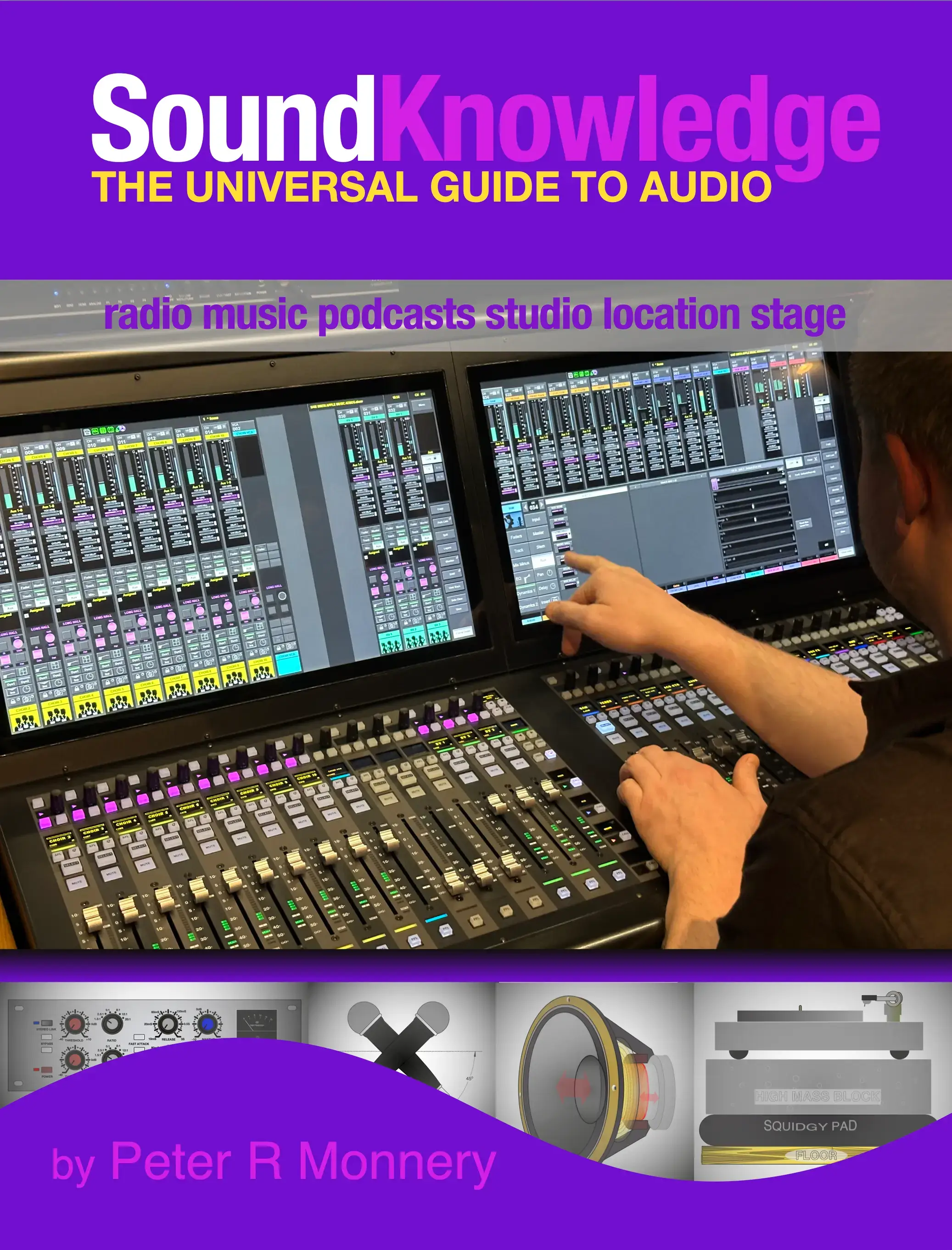
The Universal Guide to Audio
Sound Knowledge
The first complete foundation on professional audio published in over a quarter of a century.
16
Chapters
3
Appendices
171
Illustrations
Out now · Published September 2026 · Taylor & Francis · by Peter R Monnery

Full Chapter Listing
Every chapter, every synopsis.
16 chapters and 3 appendices. Each chapter builds on the last, creating an interlinked foundation across the full breadth of professional audio. Click any chapter to read its synopsis.
Introduces the physical properties of sound waves including wavelength, frequency and amplitude. Sound wave behaviour is examined over external terrain and in rooms. The terms Hertz and Decibel are introduced. Harmonics are investigated with a test case made of the clarinet. The physical properties of the ear are revealed, introducing spatial awareness, Equal Loudness Contours, age-rated impairments and physical damage. Four archetypal types of sound perception are discussed alongside the concept behind stereo sound, ending with the Sound Level Meter.
A wide-ranging chapter designed to get an enthusiastic podcaster up and running with concise, targeted information. Different spaces and needs are analysed, rudimentary acoustic tricks introduced, and solid guidance given on gaining a professional result. A targeted precis of material provided in detail across the book, and a solid multidisciplinary guide to achieving a high standard.
Answers in full why a light grounding in electronics is fundamental to learning about sound technology. DC and AC circuits, potential dividers, sound as an AC signal generator, and circuit components which can modify it. An introduction to audio levels, impedance in real circuits, and how this creates low pass, high pass and resonant filters. Transformers, active electronics, discrete transistors, integrated circuits, and RMS volts for sound level measurement.
Introduces the microphone through various transducer technologies, raw directivity and typical uses. The evolution of transducers and differing polar patterns. Microphone characteristic impedance, internal and external transformers, and balanced line working. Microphone positions, stereo recording techniques, the XLR connector, cables, and practical observations for day to day use.
Design of an electricity to sound transducer, driven by the power amplifier. Cabinet and driver phase, passive and active crossover circuits. Three popular enclosure designs. Speaker measurement parameters: frequency response, sensitivity, time alignment and directivity. Stereo monitoring positioning, studio monitoring fatigue, public address specialisms including 100V line, column designs, foldback systems and hearing loops.
Visual metering as a dependable complement to the ear. Two universal world standards in detail. The decibel reevaluated as an introduction to professional levels and their comparison to domestic ones. Connectors for each system. Dynamic range, headroom, the noise floor. Types of system noise. Loudness measurement for analogue metering and LUFS digital metering. Pink noise as a measurement tool, and stereo analogue monitoring in the broadcast chain.
The recording of sound started 150 years ago and has a long, convoluted and exciting history. Much of the nomenclature and work methods in audio technology are still rooted in previous generations of equipment. A guide to what came before digital: from before the invention of electronics through the paths of disk and tape technologies still with us in the 21st Century. Practical tips on handling archive material.
How sound reacts in the studio space, often irreversibly changed before capture by the intended microphone. Sound proofing and methods to achieve isolation from unwanted noises including troublesome resonances. Silenced ventilation. The behaviour of sound within a room: taming reflections to meet an RT60 value and avoiding low frequency standing waves. Porous and membrane absorbers.
What digital audio is, how it is created by coding and recovered by decoding. The history of compacted digital audio, through lossy and lossless systems. Digital level monitoring. Recording formats in the studio and at home, how digital equipment is joined together, methods of transport by wire, fibre and through the air, and the revolutionary 32-bit float recording format.
The primary tool of the sound engineer. An analogue desk schematic stepped through from input connections to the mix matrix. Detail of each section with a guide on expected levels. Mid-Side recording using the desk with an array of two microphones. An overview of THX multichannel sound, multi-channel acquisition, and quality monitoring.
The evolution of sound synthesis in the context of the audio engineer. Its origins, and how sounds are constructed by harmonic changes to a waveform. Three common modes of sound synthesis and the envelope generator. A short history helping explain the evolution of musical styles. Computer emulation of hardware legends in software, and a revision of MIDI.
The esoteric sound crates patched to the main desk by looms of wires over the decades. Now many are a free download in digital form. The reasoning, history and evolution through to today's prosumer mixers with inbuilt effects. Stepping back to the analogue roots that so many digital effects look to emulate.
Opportunities on the road, from a private home to a professional venue. Safety considerations. A great recording is not chance, it is about smart planning and good communication. The introduction of video and how the relationship with sound works.
Support for a student at the start of practical studio sessions. Roles in radio discussed in depth alongside student choices in media courses. Detailed tips on improved presenting of radio programmes and podcasts, and on professionally preparing recorded talks for transmission.
A step through the history of balance techniques, with each era subjected to the strides in technology that made new approaches possible. Home production and working with others in a professional environment. Listening to others, trusting what you are hearing, true monitoring and visual measurement, and how to learn to listen.
Dedicated to supporting students in the various strands of sound technology to have confidence in real world situations. What can go wrong, examining both operational and physical settings to give an advanced media student a toolkit to avoid problems before the event and solve them on the day.
Appendices
Builds on Chapter 4, moving from theory to practical use in everyday situations. General practical points about positioning, followed by twenty instrument scenarios designed to stretch ambition and build confidence incrementally.
Returns to acoustics in more detail across differing scenarios: at home, in the studio and in public buildings. The differences in acoustic criteria an architect will need to consider in creating a professional space.
Guides the reader to create practical panels for room acoustic control. Further theory transposed into designs for effective tailored home-built absorbers at a fraction of the cost of commercial products, including the ground-breaking TEWBA absorber.
Why This Book
Unique Build.
Complete foundation
The first book to cover the full breadth of professional audio in over 25 years. Sound techniques, production values, physics, electronics and acoustics, interlinked so each concept builds on the last.
Accessible to all backgrounds
Designed for students from both artistic and engineering backgrounds. The maths is either simple or simply not there. Complex issues are demonstrated through parallels taken from everyday life.
Built from real experience
Recreated from BBC Wood Norton training, production courses, staff training, and refined through years of university and college lecturing. Written by someone who has lived and taught this knowledge for over four decades.
171 smart illustrations
Every illustration is designed to clarify, not decorate. Visual explanations complement the text, in the main using unique colour illustrations (colour blindness adjusted) to support creative learning across all the chapters and appendices.
Get the Book
Available now
In paperback and hardback
Published by Taylor & Francis. Available through major retailers worldwide.
ISBN (paperback): 9781041205791
ISBN (hardback): 9781041205807
Instructor? Request a Desk Copy for evaluation.
Additional retailers (Waterstones, Barnes & Noble) will be added as listings become available.